
From Reactive to Predictive – Where AI Actually Drives Revenue
The devil is in the data
The first P in our 4P AI Marketing Leadership Model stands for Predict and it’s about using data and AI to drive smarter, more proactive revenue decisions.
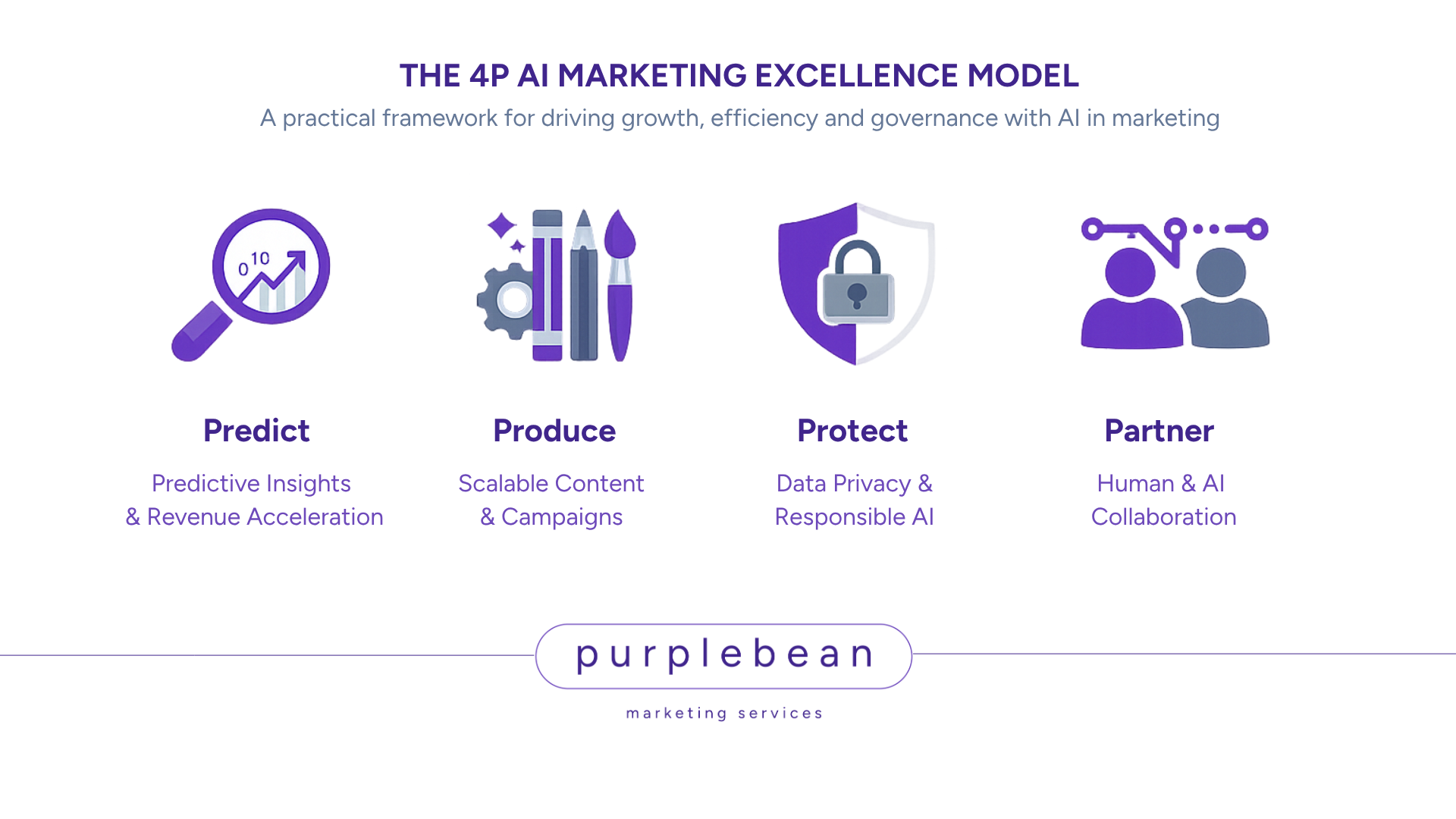
The 4P AI Marketing Excellence Framework aims to provide an overview on useful ways to leverage AI in marketing.
For a long time, marketing has largely been reactive. We analyse last quarter’s campaigns. We review which channels performed best. We optimise based on what has already happened. AI allows us to move beyond that.
As highlighted by McKinsey & Company, modern marketing increasingly relies on AI-driven decision engines that score customer propensities and predict next actions.
By analysing patterns across large datasets such as web analytics, CRM interactions, purchase history and other engagement signals, AI can begin to predict what is likely to happen next such as:
Which leads are most likely to convert
Which customers may be at risk of churn
Which channels are most likely to deliver efficient growth
This changes how marketing and sales teams prioritise effort.
Instead of treating every lead equally, attention shifts to those with the highest probability of conversion. Media spend can be dynamically adjusted based on real-time performance. Campaigns evolve continuously rather than in fixed cycles.
In theory, this is where AI starts to directly influence revenue outcomes however there’s an important caveat. The quality of the output is entirely dependent on the quality of the input.
Fragmented data, inconsistent tracking or disconnected systems will limit AI’s effectiveness very quickly. And this is where many organisations run into challenges.
There is often a tendency to jump straight into AI tools – any tools, really - without first addressing the underlying (data) foundations. This has always been problematic, even way before AI. Working on the data in the background isn’t glamorous and it doesn’t deliver instant wins, but now, AI amplifies the issue. AI doesn’t fix data problems; it scales them, accelerates them, and makes them harder to spot.
To truly benefit from predictive marketing, organisations need to invest in the less visible work:
Strong data governance
Integrated systems
A coherent marketing technology stack
Consistent tracking and measurement including human validation of outputs
It is what separates organisations that experiment with AI from those that actually extract value from it.
AI doesn’t magically create growth.
What it can do – if implemented on solid foundations - is improve how we prioritise decisions that drive growth.
