
AI in Marketing - Hype, Opportunity and a Reality Check
AI has well and truly given marketing a shake-up.
Industry observers frequently compare this moment to earlier technology waves like cloud computing or big data. Having watched those transitions unfold, I would argue this one feels even bigger. The pace is faster. The accessibility is broader. And for the first time, we’re not just transforming infrastructure. We’re augmenting (and in some cases automating) thinking.
Depending on who you speak to, it’s either the biggest opportunity we’ve seen in decades, or the predecessor to a scary, ‘Terminator’-like future. The truth, as always, sits somewhere in between.
There are genuinely powerful opportunities emerging, particularly in how we use data, make decisions and scale execution. But alongside the excitement, there’s also a fair amount of noise.
Questions around job displacement. Assumptions that AI will replace entire marketing functions. Organisations reducing headcount on the premise that “the tool will pick up the work.”
What’s often missing from the conversation is a grounded, practical view of where and how AI actually creates value in marketing and for businesses - and where it introduces risk.
Many executive teams I speak with today have AI firmly on their strategic agenda. But when you look a layer deeper, at how it’s actually being used in practice inside marketing functions, things become less clear.
Most of us in marketing have grown up with the traditional 4Ps - Product, Price, Place and Promotion - as a simple way to emphasise the pillars of marketing.
When thinking about AI, I found myself coming back to that same idea.
To bring some clarity to what can otherwise feel like a very broad and noisy space, I’ve applied this familiar framework to AI adoption in marketing.
I think of it as:
The 4P AI Marketing Excellence Model
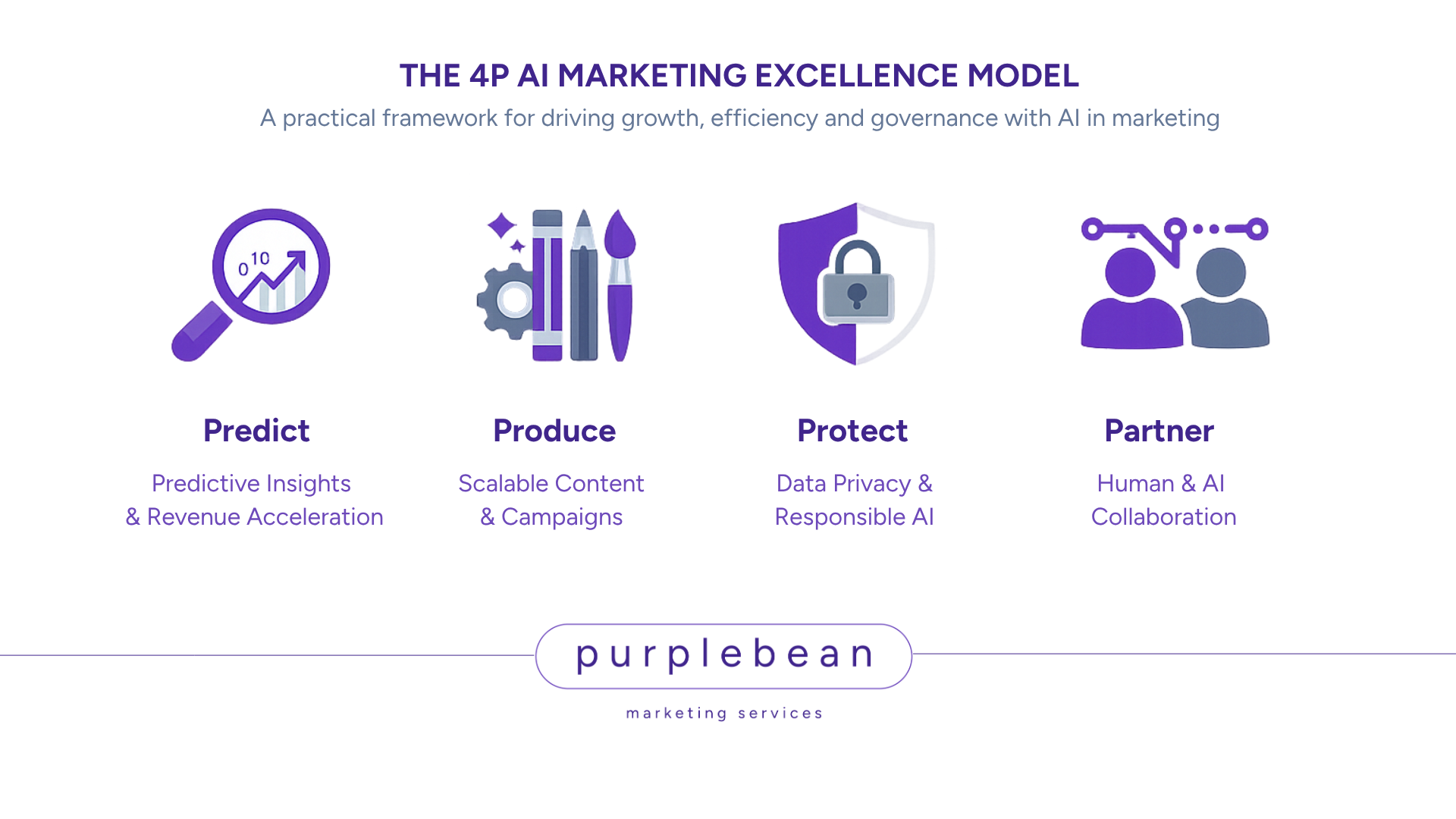
The 4P AI Marketing Excellence Framework aims to provide an overview on useful ways to leverage AI in marketing.
Predict: Using data and AI to drive smarter, more proactive revenue decisions
Produce: Scaling content, campaigns and execution through automation
Protect: Ensuring data privacy, governance and responsible AI use
Partner: Building the right collaboration between human expertise and AI capability
Over the next few posts, I’ll unpack each of these in more detail.
Because ultimately, AI in marketing is not just a technology conversation.
It’s a leadership one.
