
AI in Marketing: Productivity Promise and GTM Imperative
The second P (Produce) in our 4P AI Marketing Excellence Framework reflects the most visible impact AI is having on marketing today: Informing strategy and ideation, while also scaling content, campaigns, and execution through automation.
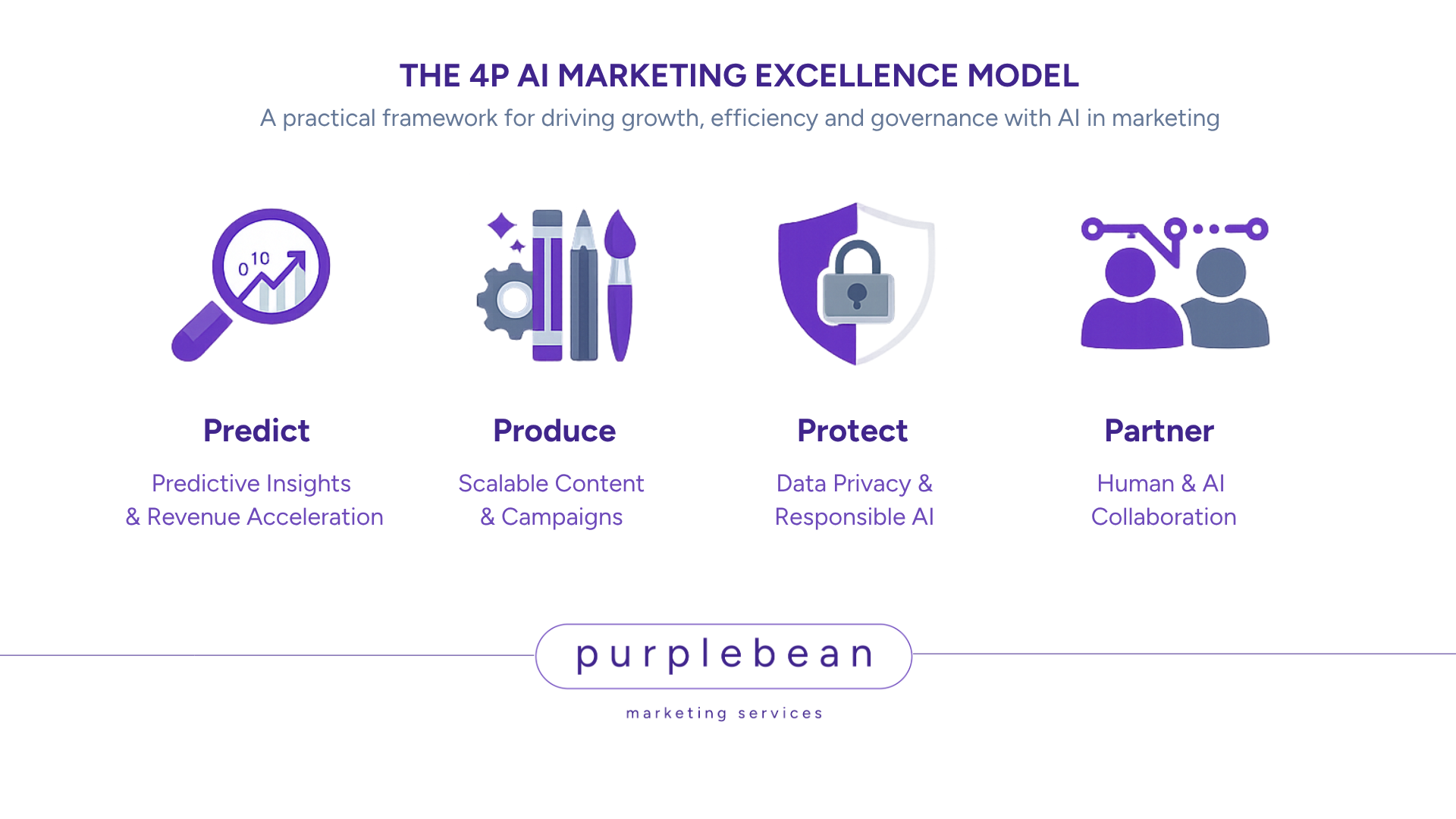
The 4P AI Marketing Excellence Framework seeks to provide an overview on how to leverage AI effectively and responsibly for marketing.
If AI’s direct impact on revenue is still evolving, its impact on productivity is already undeniable.
Marketing leaders have traditionally spent a significant portion of their time researching, gathering, and distilling information to inform go-to-market, marketing, and content strategies. Meanwhile, much of their teams’ time has been spent on repetitive, execution-heavy tasks such as:
Drafting content
Creating, resizing, and repurposing creative assets
Pulling and formatting reports
AI excels at accelerating both strategic preparation and executional delivery.
AI language models such as Claude are increasingly being used to synthesise large volumes of market data, customer feedback, internal documentation, and performance insights to help teams move faster from insight to strategy. It can surface patterns that inform who to target, how to position, what messages will resonate, and where to invest - all core components of effective GTM strategy.
In this sense, AI is not just a production engine but a strategic co-pilot.
Marketing strategies that once took weeks to create can now be drafted in hours. Content can be generated in seconds. Campaign variations can be produced at scale. Reports that once took hours can now be created almost instantly.
For teams operating under tight timelines and constrained resources, this is transformative. But focusing on the productivity aspect alone can introduce real risks.
The Differentiation Challenge
When many organisations use similar AI tools trained on broadly similar data, outputs inevitably begin to converge. We are already seeing this play out:
More content
More noise
Less differentiation
This creates a paradox: AI makes it easier than ever to go to market - but harder than ever to stand out.
It was already difficult to cut through the clutter before AI - now, with exponential increases in content production, differentiation becomes even harder. The risk is not simply content saturation; it’s strategic sameness.
If businesses rely too heavily on AI-generated outputs without strong human direction, positioning can quickly become generic, messaging can lose authenticity, and brands can start to sound increasingly alike.
The same applies to AI-generated imagery and video. While the technology is impressive, overuse without careful brand oversight can dilute brand perception rather than strengthen it.
AI is highly effective at scaling production and supporting analysis, but it is far less effective at creating true originality.
The Right Operating Model: AI + Human Strategy
For leadership teams, the challenge is no longer just about efficiency. It’s about maintaining distinctiveness.
The organisations navigating this successfully draw a clear line between where AI adds value, and where humans must lead.
AI supports:
Analysis and research
GTM planning and strategic exploration
Content and campaign production
Execution at scale
Humans remain responsible for:
Defining positioning and narrative
Making strategic trade-offs
Creativity and storytelling
Ensuring originality and emotional resonance
Protecting brand identity
AI can help organisations understand markets faster, analyse customers more effectively, and accelerate decision-making.
But it shouldn’t be relied upon to make decisions on what a brand stands for, why customers should care, or how said brand creates emotional connection and differentiation.
Just like most of us wouldn’t take input from a collaborator at face value, AI outputs still require scrutiny, judgement, and context. Human experience, commercial understanding, and intuition remain critical - particularly when shaping strategy and brand direction.
The Shift from Productivity to Advantage
In a world where everyone can produce more, faster, competitive advantage no longer comes from volume alone.
It comes from clarity, differentiation, strategic thinking, and the ability to combine AI-driven scale with human originality.
