
Finding the Sweet Spot: Human and AI Collaboration in Marketing
Throughout this series we've explored the mechanics of predictive AI: From lead scoring and churn prediction to media allocation, how generative AI is reshaping content and go-to-market strategy, and what responsible governance looks like inside a modern marketing organisation. This final post reflects on the fourth P: Partnership, and specifically, how to build the right collaboration between human expertise and AI capability.
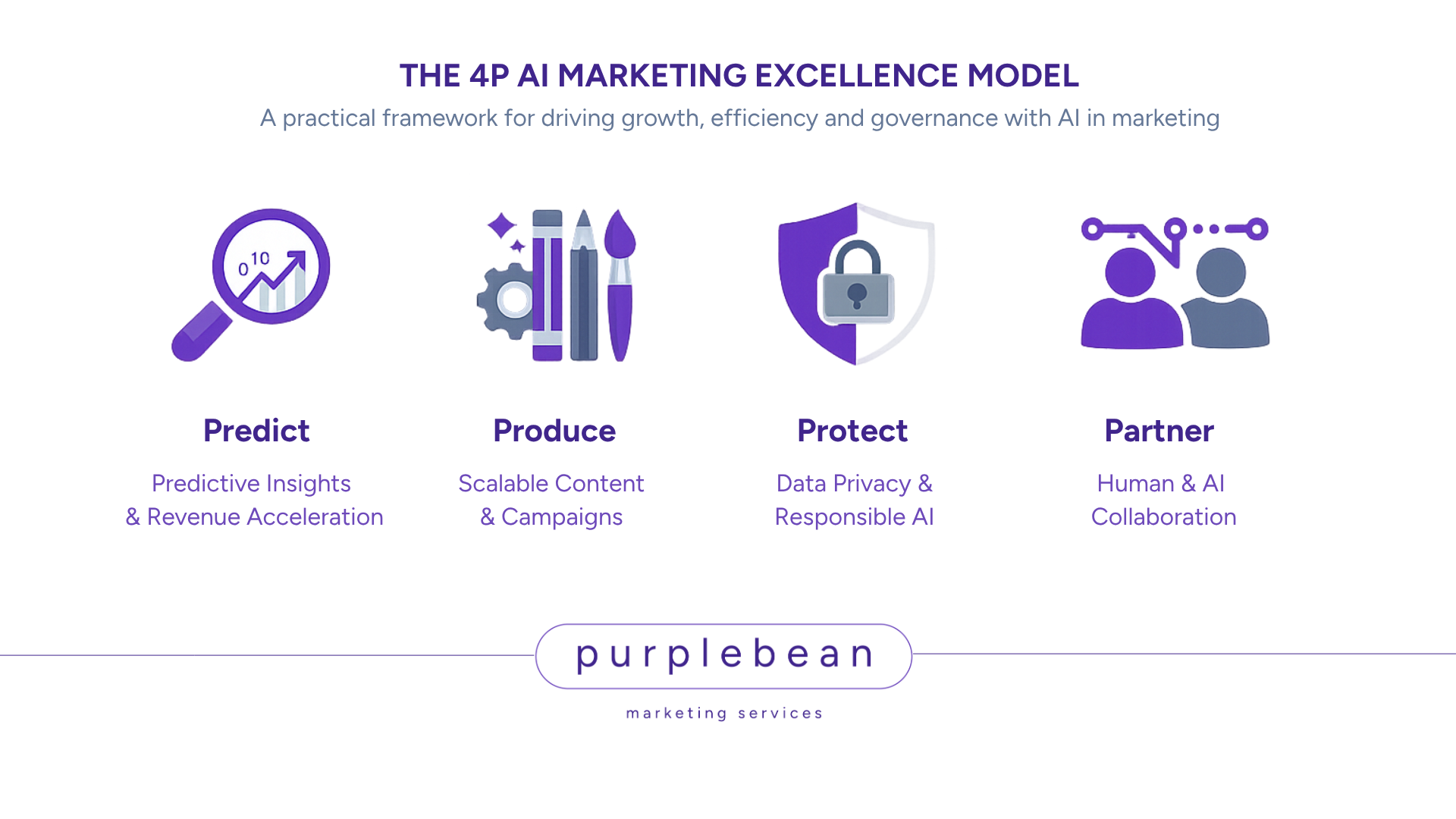
The 4P AI Marketing Excellence Model acts as a framework for efficient and responsible AI use in marketing.
The biggest challenge with AI adoption is often not technological. Most marketing teams already have access to a growing number of AI tools. What many organisations (and individuals) lack is a clear understanding of how to integrate those tools into their workflows and decision-making in a way that actually creates value. And that problem isn't getting easier. The sheer volume of content, commentary, tools, and competing claims on the topic has created its own kind of paralysis. When everything is urgent and everything is transformative, it becomes genuinely hard to know where to start - or what to trust.
The answer lies in going back to basics. AI wins on pattern recognition, scale, speed, and prediction. Humans win on judgement, context, emotional intelligence, and originality. Success comes from knowing which problems belong to which column.
| AI Strength | Human Strength |
|---|---|
| Pattern recognition | Strategic judgement |
| Scale | Context |
| Speed | Emotional intelligence |
| Variant production | Originality |
| Predictive modelling | Commercial trade-offs |
But there's a bigger ambition worth naming here, and it's one that should sit at the heart of every AI marketing strategy worth its salt: I call it the win-win-win.
A win for the organisation - better results, smarter allocation of resources, faster execution. A win for the team, meaning less time on the repetitive and mechanical, more time on the work that actually requires human intelligence and judgement. And a win for the customer: More relevant, more useful, less wasteful communication that helps them make better decisions. Could there be a world where AI can actually help reduce the noise that erodes trust over time?
It may sound overly idealistic, and it might not always be feasible to achieve. The win-win-win is a choice about how we deploy AI, not a guaranteed outcome of deploying it. Which is precisely what makes it a useful principle. If you use it as the design brief in asking, ‘Does this deployment create genuine value for all three?’, it becomes a filter that improves your decisions before you build, not after.
The case studies below seem good examples of what this can look like in practice. They show there is no single AI playbook - only a set of principles applied differently depending on context, data maturity, and desired outcomes.
1. L'Oréal - AI as Your Best Sales Consultant
Challenge: Move beyond generic beauty advice to build purchase confidence and increase online conversions.
Solution: L'Oréal built two interconnected AI tools - ModiFace for virtual try-ons and SkinConsult AI for photo-based skin diagnostics. Together they deliver instant, personalised product recommendations at scale. A customer uploads a selfie; the AI analyses their skin, maps their face structure, and renders product application in real time - effectively automating the role of an expert in-store consultant.
Human-AI interface: Human creative teams define the product catalogue, brand guidelines, and the parameters of what the AI recommends. AI handles the personalised delivery. The human judgment is upstream; the AI executes at scale downstream.
Tools used: Proprietary computer vision and deep learning models (ModiFace, developed in-house).
Results: Over 1 billion virtual try-ons - confirmed by L'Oréal's CMO. Conversion rate lifts and diagnostic volumes are widely reported by secondary sources but not independently verified by L'Oréal directly; the directional impact on purchase confidence and conversion is well evidenced even if specific multiples should be treated as indicative. The core story - that removing purchase uncertainty drives conversion - is consistent across all reported data.
Key takeaway: AI can act as your most effective sales consultant, removing friction and lifting conversions at a scale no human team can replicate.
2. Nike - Predictive Personalisation as a Retention Engine
Challenge: Stand out in a crowded apparel market by deepening customer relationships and driving repeat purchases.
Solution: Nike's predictive AI analyses app usage, purchase history, and social signals to deliver hyper-personalised product recommendations - effectively a design studio for every individual user. The more a customer engages, the sharper and more accurate the recommendations become. The model also powers training plan suggestions, early product access, and personalised content through the Nike app, turning the product into a data flywheel.
Human-AI interface: Nike's data scientists and marketing strategists set the commercial objectives and guardrails. The AI runs the personalisation logic autonomously within those parameters, with human teams reviewing performance and adjusting the model based on campaign outcomes.
Tools used: Proprietary machine learning models; data ingested from Nike apps, Nike Run Club, Nike Training Club, and purchase history
Results: Significant increases in engagement and repeat purchase rates. Comparable predictive personalisation models have demonstrated repeat purchase rate increases of up to 30%. Nike's direct-to-consumer revenue - in which the app ecosystem plays a central role - has grown substantially year-on-year, with the AI layer a recognised contributor.
Key takeaway: Predictive AI turns your first-party data into a retention driver. This is the metric your CFO actually cares about.
3. Farfetch - Unlocking Untapped Value in Email
Challenge: Break through inbox fatigue and improve performance across email - one of the most mature but often under-optimised channels in the marketing stack.
Solution: Farfetch deployed Phrasee, an AI platform that optimises email copy - subject lines, preview text, and CTAs - by learning from engagement data over time. Rather than relying on human intuition or A/B testing a handful of variants, Phrasee generates and tests language at scale, identifying the patterns that drive opens and clicks for specific audience segments.
Human-AI interface: Human marketers set the campaign objectives, brand voice parameters, and audience segmentation. Phrasee handles copy generation and variant testing autonomously, surfacing insights back to the team. It's a clear example of AI taking ownership of execution within a human-defined brief.
Tools used: Phrasee (natural language generation and optimisation platform)
Results: 7% higher open rates on promotional emails; 31% higher on triggered emails. Click-through rates improved by 25% for promotional campaigns and 38% for triggered messages. Significant revenue uplift attributed directly to language optimisation.
Key takeaway: Even your most established channels have untapped performance potential. AI finds the marginal gains that human testing at scale cannot.
4. Verizon - AI Prepares, Humans own the Relationship
Challenge: Operate at an enormous scale, with millions of customer interactions daily across retail, call centres, and digital, while maintaining the human quality of those interactions and reducing churn.
Solution: In 2024, Verizon deployed a suite of GenAI initiatives designed to make human staff more effective, not redundant. When a customer enters a store, AI generates a real-time profile including account history, current plan, device age, behavioural signals and surfaces tailored promotion recommendations to staff before the conversation begins. In the call centre, predictive AI anticipates the reason for 80% of incoming calls before the customer speaks, routing them to the right agent immediately. A separate churn prediction engine identifies at-risk customers and triggers targeted outreach before they leave.
Human-AI interface: Staff remain the face of every interaction. AI operates as a silent preparation layer, equipping humans with better context, sharper recommendations, and faster routing. This is AI augmenting human judgment rather than replacing it, and the results reflect that design choice.
Tools used: Proprietary GenAI systems built on Google Cloud and Azure OpenAI infrastructure; predictive modelling on customer data platforms
Results: These figures are important to contextualise: 100,000 customers retained, 7-minute in-store reduction, and 80% call prediction accuracy were stated as targets and projections by CEO Hans Vestberg in mid-2024 but not confirmed after deployment, hence the results should be read as the intended impact of the programme rather than audited figures.
Key takeaway: The most powerful AI deployments don't remove humans from the loop - they give humans better tools to do what only humans can do well.
5. Old Dominion Freight Line — Enterprise-Grade Content Operations at Mid-Market Scale
Challenge: One of the largest freight carriers in the US, ODFL had deep operational expertise but a lean marketing team relative to its content needs. Maintaining SEO-optimised content across hundreds of routes, services, and customer segments was beyond the team's bandwidth but the business case for outsourcing at scale didn't stack up either.
Solution: ODFL adopted Jasper, an agentic marketing platform built specifically for enterprise content operations. Jasper ingests brand guidelines, tone-of-voice standards, and approved messaging frameworks to generate on-brand outputs by default. Agents autonomously research keyword clusters, draft long-form SEO content, and produce multi-channel campaign variants from a single brief, with brand compliance embedded rather than reviewed after the fact.
Human-AI interface: Marketers operate as strategists and editors, not writers. They define the brief, review outputs for accuracy and business context, and make final publish decisions. Jasper handles the heavy lifting of first-draft generation and structural consistency. Human judgment is concentrated where it matters most.
Tools used: Jasper (agentic marketing platform with brand intelligence layer); integrations with CMS and existing marketing tech stack
Results: Accelerated SEO performance and increased content output with no team headcount increase. A Forrester study of enterprises using Jasper modelled 342% ROI over three years, $2.2M in annual time savings, $1.1M reduction in agency spend, and 50% fewer revision cycles, with a payback period of under six months.
Key takeaway: Agentic AI doesn't just accelerate content production - it lets lean teams compete with the output of organisations far larger than themselves.
What These Cases Have in Common
Purpose-built beats bolted-on: The organisations seeing the best results have configured AI to their specific context. Generic tools produce generic outputs.
Speed comes first; trust is earned over time: Every case shows dramatic acceleration in production timelines and output volume. The harder wins - brand consistency, customer trust, creative quality - require sustained human stewardship after the initial deployment.
The human-AI boundary is a design decision: Where does AI operate autonomously? Where does a human approve? Where is human judgment irreplaceable? The organisations that get this right treat the handoff as a deliberate design choice, not an afterthought.
Agentic AI raises the governance bar: As AI moves from generating content for human review to executing multi-step workflows with minimal oversight, the governance requirements shift meaningfully. The organisations succeeding here have invested in guardrails - brand intelligence layers, compliance checks, escalation pathways - before granting the agents autonomy.
And then there's the thread that connects all six: each of them, at their best, strives for that win-win-win.
L'Oréal's virtual try-on reduces wasted purchases - that's a genuine win for the customer, not just a conversion metric. Verizon's predictive routing saves customers time they'd otherwise lose on hold. Nike's personalisation surfaces things people actually want rather than blasting them with irrelevant noise. In each case, the AI was designed with the customer experience as a constraint, not just an afterthought - and that design choice is what makes the other two wins more durable.
It's worth being honest that not every AI marketing deployment gets here. Plenty are optimised for the organisation's metrics at the expense of the other two. I chose the case studies in this series at least partly because they represent the better version of what's possible - where doing it well for the business and doing right by the customer and the team aren't in tension, they're the same thing.
That should be the holy grail. Not AI for efficiency's sake, not automation for its own sake - but AI deployed with the deliberate ambition of creating value for everyone in the room: the business, the people doing the work, and the customers on the receiving end of it.
This concludes the 4P AI Marketing Excellence Model series. Thank you for reading and get in touch if you’d like to explore ways to streamline and optimise your marketing.
